2.15.2009

Special classes

I manage to continue the environmental education every week.

I decided to continue the same subject "deforestation and forest (tree) protection" for the first 2 weeks of February.

But not in the same way.

If I organise always by myself, it is very hard and also kids can be bored of it.

I said also to myself that I belonged to the Houet provincial office of Environment and Living Conditoins, I should collaborate with my colleagues !

So, for the 1st week,

I asked to one of my office bosses (forester: expert of trees) to talk about "4 classified forests" around Bobo city that I don't know so much thing about.


Why these 4 forests were classified by by the government ?

→for sustainable use of natural (forest) resources
→for the protection of local flora and soil

What can we do there ?

→Cutting trees with a permission
→Agroforestry under a contract

What is prohibited to do there?

(without permisssion)

→Culture
→Pasturage
→Hunt

Despite these rules, the forests are in danger...

She was taking notes well !

So what kids, future's adults can do to profit of these forests even until their kids' generation ?

They proposed solutions that they had discussed at the last class with me.

I learned also not only about these forests but some good points of teaching from him. He had a good technique of attracting kids' attention and of involving maximum of kids in the discussion.

Then I thought why not to go further !

Which means, I asked to the president of YANTA to tell the real experience of the women at forests when they were cutting trees illegally and right now (how it has been changed).


Whole story was told in dioula because the president said that she would be much relaxed if she could do all in dioula and I thought also the story in dioula could be more realistic.

I couldn't understand all of the story, of course but by watching kids' surpried or chocked reaction, I could see them listening carefully to her story.

However, there were always several kids who couldn't understant dioula at each class so I felt sorry for them...

Anyway at the end, we all sang a song called Enviroment for all (Protect trees).

Her and I were so happy at the end.

After, some kids came to suggest to me to go to see the women's work at forest (planting trees and cashew nuts processing) with the money they collect from each.

I was so happy to hear that because this is the point ! :take action! even though at present, I'm not sure if it is possible to make it and this will be only a visit but not doing any concret action to protect our environment.

I will try to find some possibilities.

1.30.2009

Environmental Education

Since January 19, I teach 4 classes about environment at a private college EvéliqueⅡ (junior high and high school level).

Once a week on Tuesday 7:00 (too early for me...)-9:00 and 10:00-11:00. Wednesday 10:00-11:00.

There are 60 students in one class "at least".

In the photos class, there are 88...!!!

Honestly it is impossible to control the class. (see ? how small I look in the class !)

One class is for 55mins but can you imagine how long it takes to calm kids down...

But at the same time, many of them are so active and want to answer to my questions with saying " Madame, moi (me) ! Madame, moi !!!" The atmosphere is very different from that in Japan where many kids don't react, say nothing until the teacher ask one of them to answer.

Their age in the same class varies about 11-15 years old.

That is because (I imagine) in Burkina, kids have to pass an exam to go on to the next grade from the primary school.

That day's subject was "Deforestation and forest(tree) protection".

Q1. Why there is less forests (trees)?

Q2. Why we cut trees, how we use these trees in daily life ?

If there is feu or no more trees, how it will be our life ?

Q3. So what should we do ?

At each class, I take some time to let them work on group and present their answers.

My purpose is to let them think spontaneously about different environmental problems and take action eventually.

During group work (discussion)

Some examples:

Q1's answers ;

- we cut lots of trees but we don't plant new ones,

- (especially domestic) animals walk around freely and eat up plants and trees (leaves),

-put fire on the grass to get more fields and hunt wild animals or because people believe that burn grass help to get more fertile soil.

Q2's answers ;

- firewood, charcoal,

- tables, chairs, furniture, cooking tools,

- paper, notebooks, kleenex, pencils,

- to build houses,

- a tool to throw rocks in order to hunt birds (kids do often)

I use these drawings to visualize their answers instead of writing down words.

Q3's answers ;

- do not cut too many trees,

- plant trees and take care of them,

- suggest their mother to use "improved oven" which consumes less firewood,

- do not waste paper, notebooks,

- use carefully tables, chairs,

- Control domestic animals etc.

Other (future) subjects are sanitation (washing hands, using toilets), waste (garbage), energy, water, pollution etc...

The challenges are not only to organise a active&interesting class content but also to control the whole class and to participate maximum number of students in the class.

Besides, I hope that the school teachers take these environmental issues in their class and I do that in hours when there is no other class by myself.

I am thinking how to do this...

1.22.2009

Compost vol.2

On January 12, the second compost workshop started with an association which is based in a district where one of last workshop participants lives. The association members had asked me to organise it.

I learned a lesson from the last workshop.

In Burkina, when you participate in a workshop or conference which lasts whole day or a couple of days, you can learn new things and also "receive" some money for their participation, instead of paying the fee.

It can never happen in Japan and no one expect it !

HoweverAt the last meeting of my workshop where each meeting lasted only for 2-3 hours, I gave only some vegetable seeds to the women to appreciate their great work and active participation.

At that time I felt only something different from other meetings. The women seemed tired or unmotivated.

A couple of days later, I went to one of the participants house to give her a papaya tree. She wanted to grow it with compost and show its effect to her neighbours.

Then she told me that many of the participants were disappointed because I didn't give them any money.

I was shocked. because I believed that they were very motivated to make compost. But it ended with the question of money...

But 2 of 10 promissed me to teach composting to another member of her association or her neighbours who are interested in it. So I told myself that there was at least a tiny positive outcome.

Yes, so the lesson learned from the last workshop :

Explain my intention and objective of compost workshop before starting it

1. They can learn how to make compost with home wastes,

2. No participation money will be offered, and

3. They prepare all needed materials. (with the 1st training, I learned that it was possible for women to find all materials by themselves)

A bit after 8a.m., (almost on time !) all participants came then I explained these 3 points.

Then the secretary of the association who speaks French said :

"No, no we really want to learn composting. We are all farmers but the soil is so poor that there aren't many crops every year. Gathering many crops by using compost means like making money. So we don't expect any money from you !"

The association president sitting next to me told me also in dioula :

"fields yield many crops means we get food. Food is money !"

My dioula is not so great but I think she repeated something like this.

I was very happy to hear these and assured then we started the workshop with 120% motivation!

The woman who participated at the last workshop helped me by answering directly to the questions from other participants in dioula or in morré (the 1st national language) with confidence and starting the compost base (soil) preparation.

She (in the bottom photo) is already a compost master and played very well the role of instructor (assistant) that I wished.

When we finished the workshop, the association's secretary came toward me then...

"Here, this is our contribution."

She said so and gave me a bill of 1000fcfa !

I was too surprised to say anything for a couple of seconds. 1000fcfa= 200yen = 1.5euro = 2.5 USD. But for them, it is something ! They could buy many vegetables for their kids with it ! Even for me to live here, it is something. (for lunch, one full plate of riz gras is 200-300fcfa)

Besides, at the beginning of the workshop I told them absolutely the opposite thing !

Of course, I refused to accept it because

this is my job :

as a volunteer, I can't support them financially but at least I can offer them some knowledge or techniques that I have.

Well, that is the only thing I can do really...

But they refused also to receive the money again with saying :

"you came to teach us the composting till here far from your home (30mins by bike). Buy something to eat on the way back."

I tried to give back the money for about 5min but it was impossible. I felt also it might be rude to refuse too much.

Therefore we or I decided to buy vegetable seeds before the rainy season if they succeed the composting.

Anyway, I was so touched by their spirit or attitude.

At the same time, I felt very embarrassed and ashamed of my words at the beginning...

I might hurt their dignity and kindness (warm heart)...

I learned another thing.

On 26th, it's the 2nd meeting. This time, I will attend to it with an university student who does research on utility of urban wastes for (peri) urban agriculture and its impact to the soil. He will give comments about our methods from the point of view of technical expert.

Eventually I hope to analyse the compost quality with him.

Viva compost !

1.07.2009

New Year Trip

Just After a couple of hours of sleep on Jan 1st, I headed to southern part of Burkina (touristy area) with some friends.

@Banfora :80km from Bobo

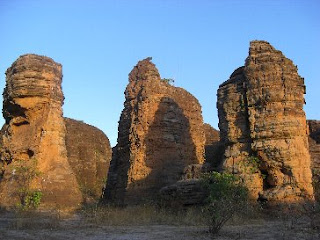
Dômes

There used to be water until the top of these rocks...

2009, 1st sunset

At night, we had japanese new year dinner (Azoni : soy sauce based soupe with mochi and veggies and salmon sushi) at a volunteer's house in Banfora☆

Hippo lake

Hippos show up only early morning usually so we went there at 6 on 2nd.

But we didn't have luck. They weren't there...

However, a beautiful sunrise welcomed us.

Cascades(waterfall)

The water was very cool and refreshed us!

Niansogoni : A village, about 80 km from Banfora, 8km from Mali border.

We stayed one night at this village.

with village kids

There were many baobab trees on the cliff

An abandoned village (houses and about 40 years ago because of hard life style. It is preserved well just because they are located under the cliff and avoid rain and too strong sun.

Cereal stores

We slept in a traditional house (case)

Kids always help cooking.

Pic de Sindou (Sindou peaks) in the village between Niansogoni and Banfora

Rocks are in very various, interesting form

I found a buddha face rock.

From the highest part, we could see at least 180 degrees of view around.

On the way, we met many people and things.


Famous Banfora suger cane fields

This is not natural fire! they make brown suger with burning suger canes in such primitive and environmentally unfriendly way...

In southern part of Burkina, cotton production is active. How was this year's harvest ?

Women are going back home after work at fields. Sorry for lots of dust from our car !

A truck Packed by laborers of some factory

A long distance bus is also packed, impossible to close the back door.

I had a great time in nature with nice people around.

Happy New Year 2009 !!!

Happy New Year 2009 !

I wish you all a wonderful year in good health and peace !

How did you spend your new year eve and new year day ?

I worked until noon on 31st which could never happen to me in Japan...

For lunch, all Japanese volunteers in Bobo got together at regional field coordinator's house and had "mochi-tuki" (rice cake making) party.

"mochi" is indispensable for Japaneses for new year celebration.

At night, I went to a dinner party at a French friend house.


I borrowed a Yukata from a friend for this official party.

At the moment of January 1st, 2009 !

Kiss, Kiss ! very very french way to celebrate a new year.

First piece of cake in 2009 :p

Then, the place became a dance hall !


The party lasted until 5 in the morning...

It was fun and very exceptional new year party !

12.14.2008

Appearance VS Health

It is already December and Christmas is very soon !

December 8th was TABASKI, the most important day (holiday) for Islam like Christmas for Christians. Bobo is very islamic city and even Christans celebrate the day with them.

Each family sacrifices a sheep (if they are capable to get one) or a chicken and shares with the family members and relatives with recalling this year and wishing a better year for the next year.

I celebrated the day with a friend (from Uruguay) at my neighbor's house with having a meal and dancing with the family's kids and their friends who came for visit. (Usually girls stay at home to prepare food and entertain visitors.)

Besides, December 11th was Burkina's Independence day. At each city, there were parades or some events although I stayed at home to take a rest.

A part from that, while it is the cold period (winter) in Japan, Europe and North America, Burkina is now in very middle of dry season.

During the day, it is still 35-40 degrees while at night and early morning, it's about 20, which is very comfortable.

Since 2 months, no rain and harmattan (seasonal wind) blows sand and dust everywhere in the city.

What I always needed when I went out with my bike were...

1. Straw hat to protect from sunburn

2. (Sun)glasses to protect from sunshine and some dust

I must already look pretty strange with these two items.

But now, in addition to them,

3. Mask to protect from sand and dust

As a result...

If I go out like this in Japan, police must stop me to ask some questions...

Of course I don't want to meet my friends when I'm biking like this !

But, with this look, less people scream at me "Chinese!" or "White!". I don't always like to be called in such way so I am happier:)

However, when I told this to a friend, she said to me "that's because you look so scary and they don't want to talk to you"...

Shocked....

Well, she is very right.

See, I show a huge smile under this full cover but who can recognize it ?

Anyway, my health is more important than my look !

The sand and dust is seriously terrible. We never know how many bacteria are in that!

Many Burkinabe put "eye"mask that we can get on the plane on their mouth.